Article
The Evolution of Watch Luminous Materials: From Radium to Super-Luminova and Beyond
In the 18th and 19th centuries, pocket watch enthusiasts struggled to read time in dim conditions. Early solutions relied on zinc sulfide, a substance that glowed faintly after exposure to sunlight but faded quickly. The discovery of radium by Marie Curie in 1898 revolutionized watch dials, enabling clear visibility in darkness. However, radium's high radioactivity posed serious health risks, leading to its replacement by tritium, which emits lower radiation levels.
Radium: The Pioneering Luminous Material
Radium emits alpha and gamma rays and has a half-life of 1,600 years. During its decay, it produces radon gas, which is highly radioactive. The first use of radium in clocks dates back to around 1917, during World War I. The American Radium Luminous Material Corporation employed female workers in New Jersey to apply radium-based paint to watch dials and hands, marking a significant milestone in horological history.
Tritium: A Safer Radioactive Alternative
Tritium, another radioactive element, decays by emitting beta rays, which excite phosphor to produce light. With a half-life of 12.43 years, tritium releases a small electron flow, making it safer than radium. By varying the phosphor content, different colors can be achieved, offering flexibility in design.
Super-Luminova: The Modern Standard
Super-Luminova was developed through a collaboration between Swiss RC Tritec and Japanese Nemoto & Co., which formed a joint venture in 1998. Its main component, strontium aluminate (SrAl2O4), is photoluminescent and non-radioactive, making it environmentally friendly. This material absorbs UV light and emits a bright glow, providing excellent visibility without health concerns.
Rolex's Chromalight: A Proprietary Innovation
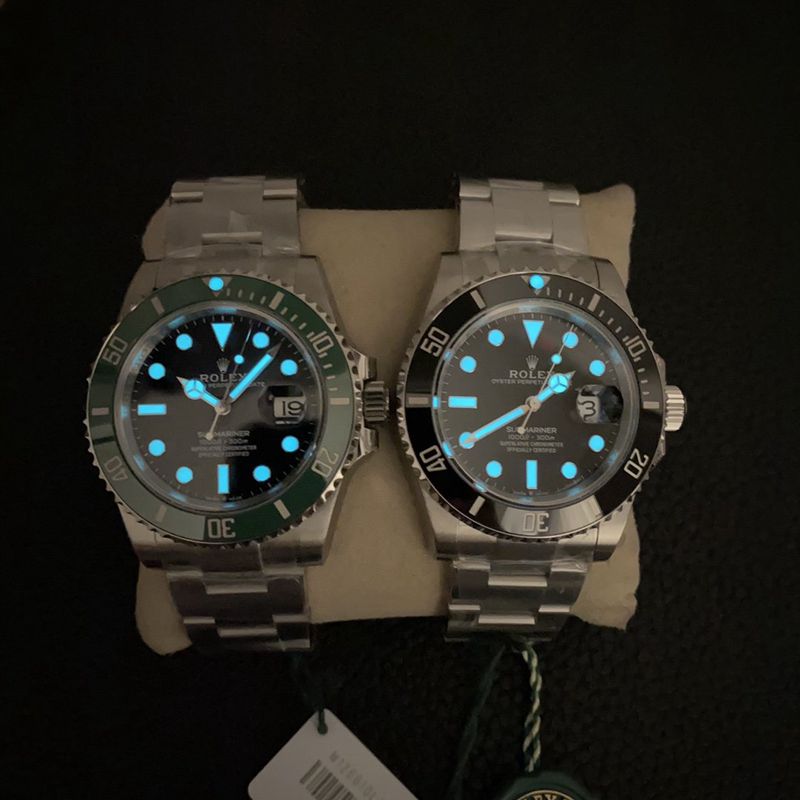
In 2008, Rolex introduced Chromalight, a proprietary luminous material first used in the Deepsea collection. Composed of metal oxides like aluminum, strontium, dysprosium, and europium, it is mixed with resin and applied to hour markers, hands, and the 12 o'clock triangle. Chromalight emits a distinct blue glow that is twice as bright as traditional luminous paints, now featured in many Rolex sports models.
BALL Watch's Micro Gas Lamps: Self-Powered Illumination
BALL Watch developed self-luminous micro gas lamps (3H) that encase tritium gas in sealed mineral glass tubes coated with a phosphor layer. These tiny lamps are bright, lasting about 25 years, and are 100 times more luminous than standard paints. They are ideal for enhancing readability on dials and hands.
Modern luminous technology has transformed watch usability, offering durability, brightness, and safety. Whether you prefer the classic glow of Super-Luminova or the innovative Chromalight, each material contributes to the functionality and aesthetic appeal of contemporary timepieces.